
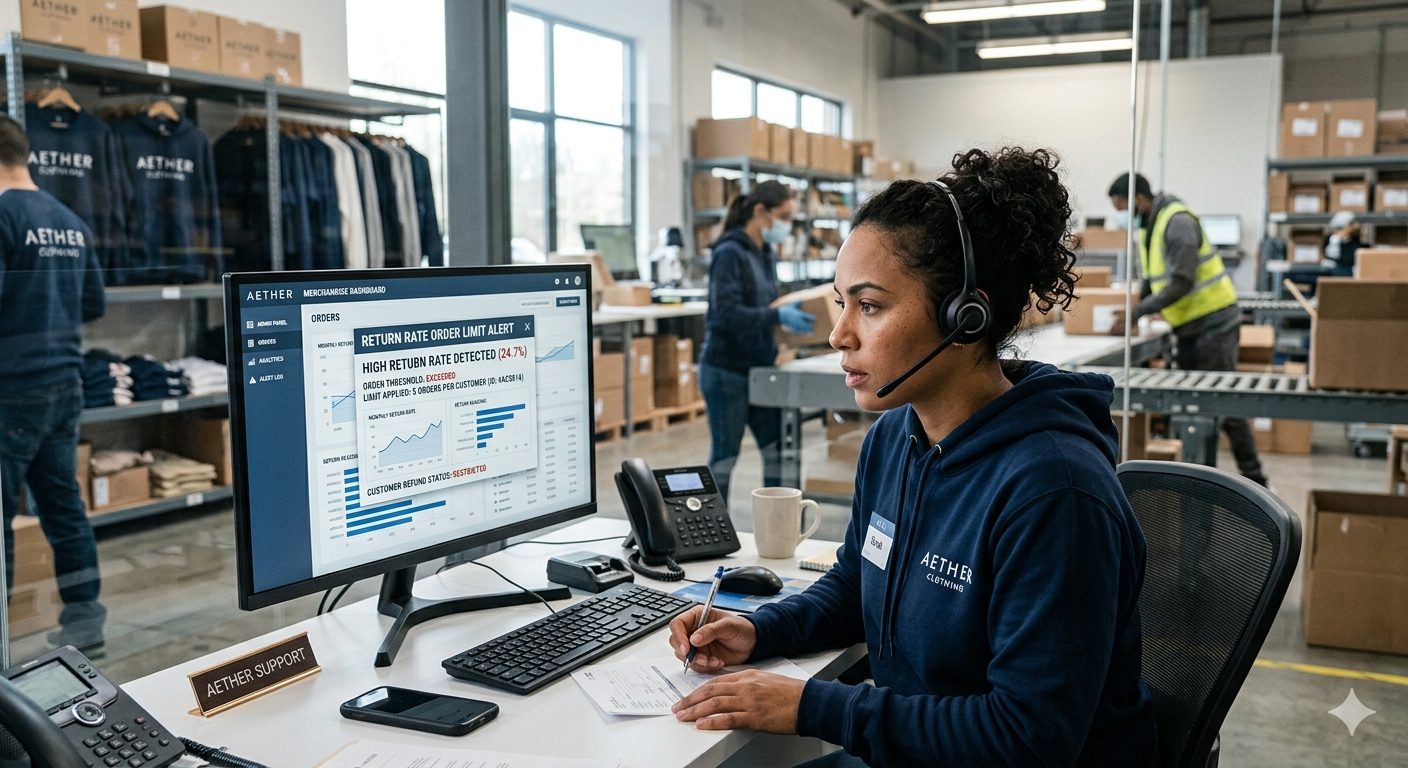
Your customer bought five colors of the same shirt. Three came back.
This happens hundreds of times a day across Shopify stores. The pattern is so common that it barely registers as unusual anymore. A customer places an order for multiple variants of the same product, intending to keep maybe one or two, and return the rest. It’s not fraud. It’s not dishonest in any technical sense. It’s just how some people shop online now.
But what if your return rate isn’t actually a product quality issue? What if it’s your ordering rules?
The Bracketing Behavior Nobody Discusses
Retail researchers call it “bracketing.” You narrow your decision space by ordering multiple options and selecting from them at home. Sizes, colors, styles. The customer gets to make their final choice without the pressure of a fitting room or the regret of ordering the wrong thing.
The math works for them. Free returns, easy shipping labels, no real friction. The math works for you too, until it doesn’t.
Processing a return costs money. The National Retail Federation data shows that the average cost to process a return is between 20 and 30 percent of the item’s selling price. That’s not just the refund. That’s labor, shipping, restocking, handling damaged items, and the overhead of managing return logistics. If a customer buys five shirts at $40 each and returns three, you’ve just eaten $36 to $54 in pure cost on a $200 transaction.
Some retailers see return rates of 20 to 25 percent. Fashion and apparel push higher, sometimes 30 percent or more. That’s not a customer satisfaction problem. That’s a business model problem, and it usually starts with how easy it is to over-order.
Impulse Buying and the Regret Cycle
Unlimited ordering creates a different kind of return rate issue. When there’s no friction, no limit, no “only X per customer” message, the purchasing decision becomes almost frictionless. Your brain doesn’t treat it as a real commitment.
You see something appealing. Your thumb moves. The order goes through. Two days later, the package arrives, and you think, “What was I even thinking?” The customer returns it.
Behavioral economics has a name for this too: the planning fallacy. When there’s no limit, your brain doesn’t force you to evaluate the purchase seriously. You assume you’ll use it. You assume it will fit. You assume you’ll love it. Then reality hits, and the return gets initiated.
The irony is sharp. By removing friction and limits, you actually increase returns. By making it hard to buy more than you need, you can reduce returns and increase customer satisfaction simultaneously.
What Thoughtful Limits Actually Do
Setting minimum and maximum order limits per product isn’t about controlling customer behavior. It’s about forcing a moment of intentionality.
When a customer sees “Choose 1 to 3 of this color,” they make a real decision. They think about what they actually want. They don’t bracket because the system has already made bracketing less appealing. The friction you’ve added is cognitive friction, not logistical friction. It happens at decision time, not at return time.
Stores that use smart order limits see measurable improvements. Some report return rates dropping from 25 percent to 15 percent or lower. That’s not a small shift. That’s the difference between a sustainable business and one hemorrhaging money on logistics.
But the benefit isn’t just financial. Customers actually report higher satisfaction. When you return less, you spend less time dealing with packaging, labels, and logistics on your side. The faster your inventory turns, the fresher your stock. The less you’re processing returns, the more capital you have for inventory that actually sells.
The Hidden Cost of Processing Returns
A lot of stores focus on the refund cost. Refund $40 to a customer, and you think the loss is $40. But that’s the visible cost.
There’s the reverse shipping label (your cost), typically $5 to $8 depending on weight and distance. There’s the time to receive, inspect, and restock the item. There’s the risk that the returned item is no longer sellable (stains, pilling, odor, damage in transit). There’s the risk that the item sits in a return bin for days or weeks before being recategorized and relisted.
There’s also the payment processing dispute risk. Every return is a customer service interaction that can escalate. If the customer feels ignored or disrespected, they open a dispute with their credit card company. Chargebacks cost $15 to $100 each in fees, and they damage your payment processor account standing.
Now multiply all of this by the number of returns you process each month. If you process 200 returns per month and your actual all-in cost per return is $60, you’re spending $12,000 a month on return logistics. That’s $144,000 per year. For some stores, that’s more than the profit margin on their entire business.
Order Limits as a Demand Signal
There’s another angle most stores don’t consider. Your order limits tell you something real about demand.
If customers are hitting your maximum order limit on a product consistently, that’s data. That product is undersized. You need more inventory or perhaps a lower price point. If customers aren’t hitting minimums, the product might not be compelling enough, or the minimum is too high.
Unlimited ordering hides this signal. Customers just buy, return, and move on. You don’t learn anything except that returns are high. With limits, you get clarity on what people actually want and in what quantities.
How to Implement Limits Without Losing Sales
The fear most merchants have is real: “If I limit orders, won’t I lose sales?” The answer is usually no, because you’re not actually losing sales. You’re preventing returns that were inevitable.
Start with high-return products. If you have SKUs that have return rates above 20 percent, set a per-customer limit there first. Set it at a reasonable level. For apparel, maybe 2 of the same color, or 1 per style. Watch the return rate drop.
The messaging matters. “Only 2 per customer” feels restrictive. “Choose your color, then add to cart” feels like guidance. The same limit feels different depending on how you frame it.
Tools like SmartOrderLimit let you set these rules per product or per variant, and show the limits directly on your cart and checkout. Customers see them before they decide, which is where the intentionality happens.
The Math That Makes Sense
Let’s do actual math. Say you’re a mid-sized apparel store processing $500,000 in annual revenue with a 22 percent return rate.
That’s $110,000 in annual refunds, plus $30,000 to $35,000 in processing costs, plus labor. You’re looking at $150,000 in total return-related expense per year.
Implementing smart order limits lowers your return rate to 14 percent (a conservative estimate based on what stores report). Your refunds drop to $70,000, your processing costs drop to $20,000, and you save maybe $50,000 in annual cost.
You don’t lose sales. You just process fewer returns. Your inventory turns faster. Your capital is more efficient. Your customers report higher satisfaction because they’re making more intentional purchases.
That’s not a small win. That’s a business transformation, and it starts with one simple principle: limits reduce regret, and reduced regret reduces returns.