
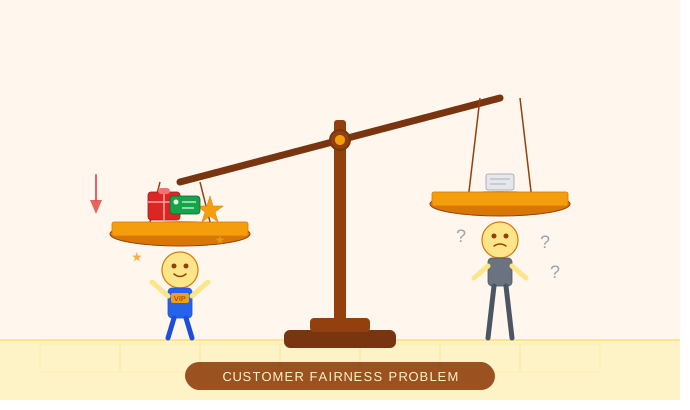
You release a limited run of a product. 200 units. You post it on Instagram. Your regular customers see it. They’re excited. They’ve been waiting for this.
Within 40 minutes, all 200 units are gone.
Except here’s the problem. One customer bought 175 of them.
The other 199 customers who showed up to buy got nothing.
This happens more often than store owners admit. And the consequences are far worse than just a single lost sale.
The Hoarder Economics
The customer who bought 175 units didn’t necessarily want them to keep. They wanted to resell them. On StockX. On Depop. On eBay. They saw an arbitrage opportunity and took it.
This is the hoarder problem. It’s not new. It’s been a problem in sneaker culture for decades. Every limited release of a hyped sneaker gets bought by resellers who immediately flip it for 2-3x markup.
You see it with gaming consoles. PS5 launched in 2020 and immediately got hoarded by resellers who sold them for $1,500+ online while customers who actually wanted to play with one couldn’t find them in stock anywhere.
You see it with Yeezys. Rare sneaker drops consistently get hoarded by resellers in the first 5 minutes.
The damage this causes to your brand is significant. But most store owners don’t measure it properly.
The Real Cost of Not Protecting Fairness
Let’s say you’re a small streetwear brand. You launch a limited hoodie. 200 units. Limited for good reason: you produced exactly 200 for your release strategy. Your regular customers are excited. This is the moment they’ve been waiting for.
A reseller bot buys 180 units in the first minute.
Your 20 regular customers get the remaining 20 units. They’re happy. But three hours later, the reseller has 180 units listed on 10 different resale platforms for $140 each (you sold them for $60). That’s $25,200 in secondary market revenue that didn’t come back to you.
But that’s just the money. Here’s the brand damage:
The 199 customers who showed up and couldn’t buy are now frustrated. They came to your store with excitement and got nothing. They post about it on social media. They didn’t get mad at the resellers. They got mad at you. ‘Couldn’t buy anything because bots bought it all’ becomes the narrative. Their Instagram stories showing empty product page? Those get 100+ likes from other frustrated customers.
Your store’s engagement goes up (more comments, more interaction) but all of it is negative. Algorithms notice the negativity. Your posts get deprioritized. Your organic reach tanks. You’re now spending more on paid ads to reach the same audience.
The psychological impact on your real customers is worse. They realize that being a loyal customer doesn’t matter. First-come-first-serve means the fastest clicker wins, not the person who actually values your brand. That’s when brand loyalty starts to erode.
Some of those customers stop following you. They follow your competitors instead. Your competitor doesn’t have this problem because they set purchase limits. One hoarder event just cost you three good customers and damaged your relationship with fifteen others.
The Resale Market Effect
Here’s something store owners don’t like to talk about: when resellers control your product, your brand loses control of the narrative.
A reseller who bought 180 hoodies for $60 each has just spent $10,800. They’re not sentimental about your brand. They’re trying to extract profit. If the market softens, they dump 50 units at $80 to liquidate. Suddenly your $60 item is available for $80 on the secondary market (below retail, but above cost for regular customers). The secondary market becomes the primary. Your markup gets destroyed.
Customers start asking: why would I buy from the official store for $60 when I can get it from StockX for $79? They don’t understand the difference. They just see price. And in their mind, StockX is clearly pricing lower (it’s not, but that’s the psychology).
You’ve lost control of the supply chain. The reseller now owns the pricing power.
The Community Trust Factor
Fairness matters in commerce. Not in the abstract sense, but in the concrete sense of: will people trust me enough to come back?
The stores that have the most fervent communities are the ones where customers feel like they have a fair shot. Not everyone gets the limited item, but there’s a system that feels fair. Everyone gets access. The fastest person wins, but at least everyone had a chance.
When you allow unlimited hoarding, you’re saying: whoever runs the fastest automated system wins. And that feels broken. It erodes community. It creates cynicism.
Compare that to a brand that says: ‘We’re limiting purchases to 2 per customer per release so that everyone who wants one can have one.’ Suddenly the community feels protected. The brand is on your side. You trust them more.
That trust translates to customer lifetime value. A customer who feels protected is a customer who buys from you again and again and recommends you to others.
The Retail Precedent
Apple knows this. During scarce product launches, Apple limits purchases to 1 per customer. They’ve done this since the iPhone 4. They know that if they didn’t enforce this limit, resellers would buy thousands of devices in the first hour. Real customers would get nothing. The community would feel broken.
Nike knows this. When they release sought-after sneakers, they frequently limit to 1 pair per customer. On their website, on SNKRS app, in stores. It’s consistent.
Lululemon has started doing this on limited release items. They’ve been burned before by reseller chaos, and they’ve chosen fairness.
These aren’t small companies making mistakes. These are some of the biggest brands in the world, deliberately choosing to sacrifice short-term revenue (from bulk reseller purchases) to protect long-term community and brand value.
How to Implement Fairness
The mechanics are straightforward. When you launch a limited item, set a maximum purchase quantity. For a 200-unit drop, maybe you set a 3-unit limit per customer. That means the maximum reseller can buy is 3. With 200 units and 3-per-person limits, you ensure 66 different customers can access the product.
Tools like SmartOrderLimit enforce these limits at checkout. A customer literally cannot complete a purchase for more than 3 units because the system blocks it. No workarounds. No reseller bots. No unfair advantages.
You can also set rules by time. For the first hour, 1 per customer. For hours 2-12, 2 per customer. This protects your absolute core fans (the people who are there in minute one) while still allowing broader access.
The secondary benefit is data. When you enforce fairness, you’re also getting a clearer picture of actual demand. If you have 200 units and 400 customers wanting them, that tells you something. That tells you that next time, maybe you produce 400 units. Or you mark it as more premium. But you know the real demand signal, not just ‘one person bought 180 and we sold out.’
The Long Game
A store owner might worry: if I limit purchases, won’t I lose that one reseller’s bulk order? Won’t I lose revenue?
Short term, maybe a tiny bit. You lose 175 units of bulk reseller revenue in exchange for protecting 199 customers’ access and community trust.
But that 199 customers who got access? Three of them will buy from you again next month because they felt valued. Fifteen of them will follow you and buy future releases. Fifty of them will tell their friends about the brand that treated them fairly. One of them becomes a superfan and buys your entire back catalog.
That lifetime value from 199 customers is far greater than the one-time bulk order from a reseller who will never buy from you again.
The fairness strategy isn’t just morally sound. It’s economically superior.