
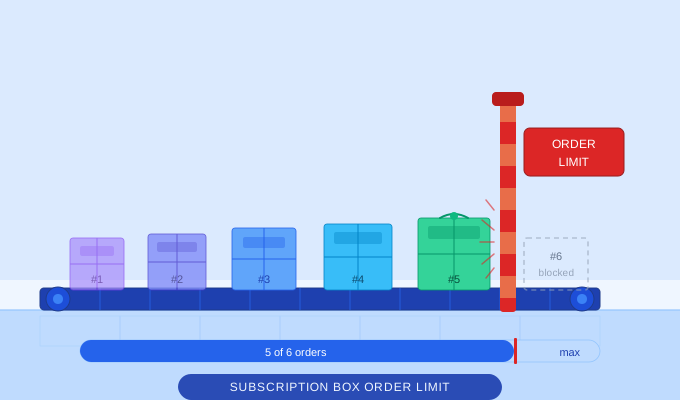
You launch a subscription box business. Artisanal coffee, curated each month. $49 per month. You expect 500 subscribers in the first month.
In 72 hours, you have 1,200 subscribers.
You’re thrilled. Then you realize you have a catastrophic problem: your supplier can only produce 500 boxes per month. You’ve oversubscribed 2.4x your production capacity. You have 700 committed subscriptions that you physically cannot fulfill.
Welcome to the subscription box death spiral.
The Unique Pain of Subscription Commerce
Subscription businesses are economically different from one-time purchase businesses. The moment a customer buys a subscription, you’ve made a commitment. You’ve promised to deliver a box to them every month, forever, until they cancel.
That commitment comes with hard costs. You’ve committed to paying your supplier to produce those boxes. You’ve committed to paying for logistics and shipping. You’ve committed to the labor of fulfillment. If you oversubscribe, you can’t just tell a customer ‘sorry, we don’t have inventory.’ That doesn’t work in subscription. They’ll cancel immediately.
Unlike a product drop where you sell 200 units and you’re done, a subscription oversubscription problem compounds every month. Every month you’re short 600 boxes, you’re losing money. You either have to pay rush suppliers at 2x cost, or you have to refund and cancel 600 subscriptions, which tanks your retention metrics and revenue.
This is why subscription box businesses fail more often than regular Shopify stores. They don’t realize until too late that you can’t oversell a subscription. It’s a fixed commitment.
The Math of Oversubscription
Let’s work through the numbers from that coffee box example. You have 500 boxes’ worth of capacity.
– Cost per box (coffee, packaging, labor): $15
– Shipping per box: $8
– Platform fees and payment processing: $5
– Total cost per box: $28
– Subscription price: $49
– Profit per box: $21
At 500 subscribers, you’re making $10,500 gross profit per month.
But you have 1,200 subscribers. You can only fulfill 500. You have three options:
Option 1: Pay rush suppliers. You source additional boxes from a premium supplier at double cost ($30 per box instead of $15). You fulfill all 1,200 subscriptions. But now your cost per box is $43 (30+8+5). Your gross profit is $6 per box. On 1,200 boxes, you’re making $7,200. That’s actually less profit than at 500 subscribers with normal costs.
Option 2: Refund and cancel subscriptions. You fulfill 500. You refund 700 customers. You get chargebacks. You have cancellations. You’ve now lost recurring revenue. That 700 you cancelled would have been $34,300 in annual recurring revenue. You just gave that up.
Option 3: Delay shipments. You tell customers that boxes will arrive late. You lose the ability to project reliability. Some customers cancel out of frustration. You become known as the subscription that doesn’t ship on time.
All three options are bad. But you created this problem by not capping signups.
The Inventory Commitment Problem
Here’s something most subscription box founders don’t think about until they’re underwater: monthly recurring revenue doesn’t show up as monthly inventory commitment until you’re actually doing it.
You announce the subscription. You get 1,200 signups. You’re excited because that’s $58,800 in annual revenue. But here’s the reality: that’s committed inventory cost of $28 per month per subscriber. That’s $33,600 in monthly production costs starting immediately next month.
Your supplier probably has a lead time. You need to commit to your supplier today for next month’s production. If you tell your supplier ‘I need 1,200 boxes in 30 days’ and you can’t actually pay for them, your supplier stops working with you.
You’re now in a situation where your cash flow is negative. You’ve committed to $33,600 in production costs. You only have enough cash to cover $14,000 in production costs for the month. You’re short $19,600. You go to your supplier and ask if you can produce 500 this month and 700 next month. They probably say no. They want stability and predictability.
You’ve just created a cash flow crisis from a subscription you can’t afford to fulfill.
How Smart Subscription Founders Solve This
The smart founders do something that sounds counterintuitive: they close signups when they’re close to capacity.
They set a hard cap on new subscriptions. Maybe they decide: we can sustainably handle 600 subscribers. When they’re at 550 new subscribers, they close the signup form. They put up a notice: ‘New signups available again March 1st.’ Customers who missed out put themselves on a waitlist.
This feels like you’re leaving money on the table. You’re turning away 50 customers who want to pay you $49. In the short term, you are leaving money on the table.
But here’s what you gain: 600 customers who consistently get their boxes on time, who trust you, who renew their subscriptions month after month. That’s 600 customers with high lifetime value. Over 12 months, that’s 7,200 boxes. That’s $147,000 in revenue at 95% retention.
Compare that to 1,200 subscribers where 40% churn in the first month because boxes arrived late and were low quality. That’s 720 subscribers by month two. By month six, you’re down to 300. You’ve made less total revenue and you’ve damaged your brand reputation.
The profitable path is: close signups, operate efficiently, keep customers happy, maintain high retention.
The Tool You Need
When you run a subscription box on Shopify, you’re often using an app like Recharge or Bold to manage recurring billing. But those apps don’t manage inventory commitments. They just process recurring charges.
You also need inventory controls. You need the ability to set maximum orders or signups based on your actual production capacity. SmartOrderLimit lets you set cart-level maximums. If you decide you can only handle 600 subscriptions, you can set a rule: ‘If cart total equals subscription box, maximum quantity is 1, and if store has more than 600 of this product sold, show a message and disable checkout.’
This prevents overselling at the checkout level. Customers can’t complete a purchase that would push you over your capacity. They see a message: ‘Subscriptions are at capacity. New signups open March 1st. Join the waitlist.’ They’re disappointed but not angry.
You’ve just converted a negative experience (unable to complete checkout) into a positive one (we’re in such high demand that we’re temporarily full, and here’s when we’ll open up again).
Managing Growth Phases
A smart subscription founder plans growth in phases.
Phase 1: Get to product-market fit with 200 subscribers. Run for 3 months. Measure churn, customer satisfaction, and operational efficiency. You might discover that your cost per box is actually $32, not $15, because you’re doing fulfillment yourself and it’s slow.
Phase 2: Based on what you learned, decide if you can scale to 500 without losing quality. Maybe you hire a fulfillment partner. Maybe you optimize your sourcing. You grow to 500. You run for another 3 months.
Phase 3: You’ve proven you can handle 500 profitably. You know your churn rate. You know your CAC. You can now plan for 1,000. You invest in infrastructure, supplier relationships, and systems.
At each phase, you use order limits to manage capacity. You grow intentionally, not accidentally.
The Churn Rate Reality
One more critical thing to model: subscription box churn. Most subscription boxes see 5-10% monthly churn. That means after one month, 5-10% of customers cancel.
If you start with 500 subscribers, you have 525 subscribers by month two (minus 25 from churn, plus 50 new). If you cap new signups at 50 per month, you’ll grow sustainably.
But if you don’t manage this and you add 500 new subscribers in month two, you’ll have 950 total. Now you’re underwater again.
By capping growth with order limits, you’re also capping your ability to accidentally destroy your business.
The Sustainable Playbook
Here’s what the sustainable subscription founder does:
- Calculate actual cost per subscription (all-in including labor, packaging, shipping, payment fees).
- Determine how many subscriptions you can handle profitably with current operations.
- Set that number as your cap (maybe 80% of max capacity to give yourself buffer for growth spikes).
- Use order limits to enforce the cap. When you hit the cap, signups close automatically.
- Track churn. Plan your next growth phase based on room created by churn.
- When you’re ready to scale, invest in operations first, then remove the cap.
This sounds slow. It is slow. But it’s the only path that leads to a profitable, sustainable subscription business.
The subscription box graveyard is full of founders who didn’t cap growth early. They grew too fast, oversold, couldn’t fulfill, and lost their customer base. The survivors are the ones who said no to unlimited growth and protected their operations.