
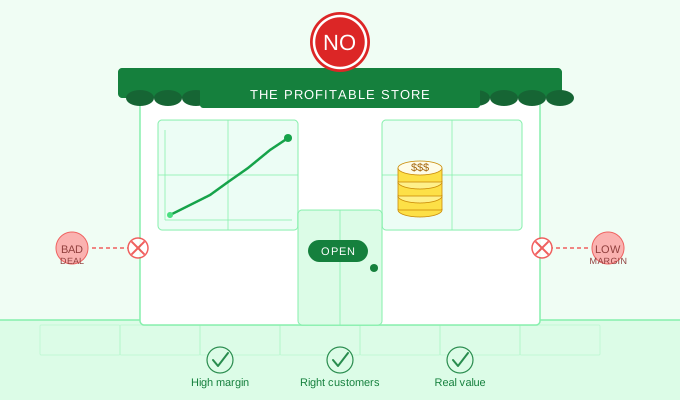
You meet a store owner at a Shopify meetup. They’re making $2 million in annual revenue. Their catalog has 47 SKUs. They’re calm. They don’t complain about inventory management. They’re not stressed about fulfillment.
Then you meet another store owner. They’re proud of their 6,400 SKU catalog. Their annual revenue is $180,000. They’re exhausted. They’re constantly chasing supplier issues, inventory imbalances, product quality complaints, and customer service emergencies.
This isn’t a coincidence. It’s the economics of constraint.
The Paradox Nobody Wants to Admit
The conventional wisdom is that more inventory options mean more sales. That’s partially true. But it’s only true up to a point. After that point, you cross into the territory where adding more products actively reduces profitability.
Here’s why. When you add a product, you’re not just adding one decision point. You’re adding complexity across every function of your business. Your supplier now has more SKUs to track. Fulfillment gets slightly slower because your warehouse is more complex. Your inventory capital gets spread thinner. Your marketing message gets diluted because you’re trying to explain more options.
The math works until it doesn’t.
Let’s say each product requires 3 hours of monthly maintenance: demand forecasting, supplier communication, inventory reconciliation, and handling exceptions. If you have 50 products, that’s 150 hours per month. That’s real work.
If you have 200 products, that’s 600 hours. You probably don’t have 15 hours per week of spare capacity. So you start cutting corners. You automate more aggressively, which means more inventory mistakes. You communicate less with suppliers, which means longer lead times and worse pricing. You spend less time on product photos and descriptions, which means lower conversion rates. Your gross margin was 50%. Now it’s 42% because you’re paying rush fees and making mistakes.
More SKUs. Lower margin. Same revenue. Lower profit.
In-N-Out and the Power of No
In-N-Out Burger generates $2.75 billion in annual revenue with a menu that has five entree options. Five. Not 50. Not 500.
Their profit margins are 6-8% (higher than most fast food chains). Their employee satisfaction is famously high. Their operations are so efficient that they don’t franchise to franchisees like every other major burger chain. They own and operate every location because they’re profitable enough to do it.
This wasn’t an accident. In-N-Out’s founder, Harry Snyder, made the deliberate choice to have a limited menu. He believed that constraints drive excellence. When you have fewer options, you get better at executing each one. Your suppliers know exactly what to expect. Your operations are predictable. Your quality is consistent. Customers know what they’re getting.
Trader Joe’s operates the same way. They have 4,000 SKUs total, but any individual store only carries about 3,500. Compare that to a conventional grocery store like Albertsons with 60,000 SKUs. Trader Joe’s gross margin is higher. Employee turnover is lower. Customer loyalty is dramatically higher.
These aren’t outliers. They’re the profitable template.
The Order Limit Strategy
But limiting products isn’t the only constraint that drives profitability. Limiting order sizes works the same way.
A store owner might say: ‘I’ll sell 5 units minimum per order.’ This instantly removes a category of unprofitable orders. Orders under $25 don’t make sense for most e-commerce businesses when you factor in payment processing, customer service, and shipping. Setting a minimum kills those sales, but they were going to lose money anyway. They’re money-destroying sales hidden by the illusion of ‘revenue.’
Or a store might say: ‘I’ll sell maximum 10 units per customer per month.’ This creates scarcity. It prevents hoarding. It forces customers to think about whether they really need that much. It also prevents bulk buyers from destroying your margins by negotiating volume discounts that eventually undercut your retail business.
These aren’t arbitrary rules. They’re strategic constraints that protect your margin structure.
The Bulk Buyer Problem
There’s a category of customer that every store owner encounters. They come in with a bulk order. 50 units. They negotiate down to 35% margin instead of your standard 50%. You do the math and think, ‘Hey, that’s still $3,500 in revenue. That’s good.’
Except it’s not good. Because now you’ve trained your supplier to expect 35% margins on those quantities. Your retail customers start asking why they can’t get the same discount. Your regular margin customers feel like they’re overpaying. You’ve created price pressure that will take months to recover from.
The most profitable stores say no to these bulk customers. They understand that protecting their standard margin structure is more valuable than one large order. A 50% margin on 100 customers is more valuable than a 35% margin on 50 bulk customers and 50 retail customers.
The Cash Flow Effect
This is the hidden leverage that most store owners don’t calculate. When you enforce order limits and say no to certain order patterns, your cash flow gets better.
Here’s why. When you have 6,400 SKUs, each with uncertain demand, you’re forced to keep high inventory levels to hedge against uncertainty. If one product suddenly becomes trendy, you don’t have enough stock. So you overstock defensively. That ties up massive amounts of capital.
When you have 50 SKUs with clear order limits, your demand is predictable. You know you’ll never sell more than 100 units per day of any single product because you enforce a 5-unit per customer limit. So you can safely stock 200 units and refresh weekly. That’s much less capital locked up.
Lower inventory means faster inventory turns. Faster turns means cash comes back to you quicker. Quicker cash means you can pay suppliers early and get better pricing. That’s your margin improvement right there.
The Information Advantage
When you say no to certain orders or order patterns, you also simplify forecasting and inventory planning. You have better information about what’s actually going to sell.
Instead of trying to predict demand across 6,400 SKUs (which is basically impossible), you’re managing 50 SKUs with clear limits. You can see trends quickly. You can adjust orders faster. Your suppliers see consistent, predictable orders from you. They allocate better inventory to you. Your lead times get shorter.
Shorter lead times mean more flexibility. More flexibility means you can say yes to market trends without taking huge inventory risk. Paradoxically, having constraints makes you more responsive, not less.
The Emotional Tax
There’s also a psychological component that affects decision making. When you’re managing 6,400 SKUs, every decision becomes a source of stress. Is this product still profitable? Should I reorder? Why is this customer complaining? Is this supplier reliable? Why did this product stop selling?
After months of this, decision fatigue sets in. You make worse choices because you’re burned out. You accept bad supplier terms. You negotiate poorly. You miss market opportunities because you’re too tired to think about strategy.
The stores that are most profitable aren’t the ones with the most products. They’re the ones where the owner can still think clearly about strategy because they’re not drowning in operational detail.
How to Implement This
The first step is being honest about which products are actually profitable. Most store owners have 10-20% of their catalog generating 80% of their revenue. Identify those products. Those are your core.
The second step is setting order limits that protect your business model. You can use tools like SmartOrderLimit to enforce minimum and maximum order quantities at checkout. Set minimums that eliminate unprofitable small orders. Set maximums that prevent hoarding and protect your margin structure.
The third step is being brave enough to say no to products and customers that don’t fit your model. That bulk customer asking for a 40% discount? No. That niche product that sells three units per month? Consider discontinuing it.
This sounds counterintuitive. But every store owner who’s tried it discovers the same thing: less is more. Fewer products, tighter constraints, better operations, higher profit.
The question isn’t whether you can afford to have fewer products. It’s whether you can afford to have more.