
The email arrived on a Tuesday morning. Subject line: “We can only manufacture 500 units.”
By that point, 1,247 customers had pre-ordered your product. Your inventory spreadsheet showed it in bright green. The product page showed “Pre-order available now.” You had already spent the pre-order revenue on the manufacturing run.
Now you had a problem that money couldn’t fix.
This is the pre-order trap. It’s not unique to small brands. It’s happened to everyone from independent Shopify stores to mid-sized ecommerce companies. The trap works like this: you list a product for pre-order. No hard cap on quantities. Customers buy freely. Your Shopify dashboard shows revenue climbing. You feel successful.
Then manufacturing reality hits.
Pre-Orders Will Break Your Heart (Unless You Set Hard Limits)
The cascading failure of an uncapped pre-order looks like this:
First, you communicate the inventory shortfall to customers. Some understand. Many don’t. You receive 300 support emails asking for refunds. You start issuing refunds, which tanks your gross margin on the whole product launch.
Second, you have to figure out who gets the 500 units you can actually make. Do you fulfill first-come-first-served? That’s fair but slow to explain. Do you pro-rate orders? That requires manual calculation and coordination with your payment processor. Do you select random orders to fulfill? Customers who got bumped feel cheated.
Third, you start shipping partial orders. A customer ordered three units. You send them two. They receive a partial shipment notification, which triggers more support requests. “Where’s my third unit?” “When will the rest come in?” “Should I just cancel and order somewhere else?”
Fourth, your brand trust erodes. The product that customers excited about now comes with a bad memory. The launch that was supposed to build momentum instead becomes a cautionary tale customers tell their friends. “Yeah, don’t pre-order from them, they oversold.”
You can’t undo this once it starts.
Why Pre-Orders Go Wrong
The psychology of pre-orders is deceptive. When a product isn’t available yet, something in us wants it more. You get early access. You secure your unit before they sell out. The FOMO is real, and it drives sales.
But that same psychology makes customers assume there’s a limit. If you’re taking pre-orders, there must be a reason, right? You must know how many units you can manufacture. So customers feel reasonably confident clicking “pre-order” even if they don’t see a quantity limit stated explicitly.
You, the store owner, are usually planning based on optimistic manufacturing estimates. Your supplier says they can probably do 700 units. You think, great, I’ll take pre-orders with a 1,000 unit cap. Except your supplier is also optimistic. There are delays. A component becomes harder to source. By the time production actually starts, that 700-unit estimate has shrunk to 450.
This gap between what you promised and what you can deliver is where trust dies.
How to Run Pre-Orders That Don’t Implode
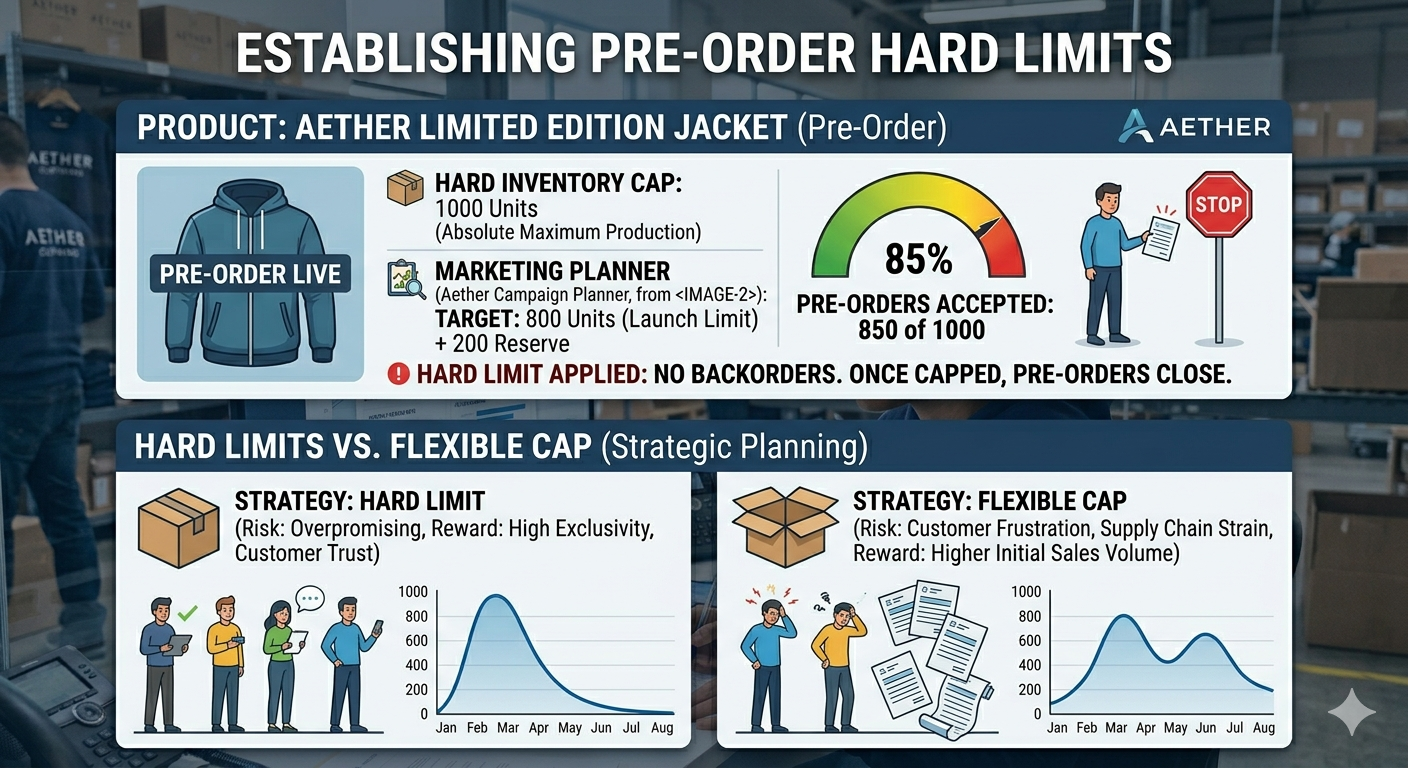
Smart brands approach pre-orders differently. They set hard limits before the campaign even starts.
First, you talk to your manufacturer. Not optimistically. Conservatively. What’s the absolute realistic cap for production? If they say 500, you cap pre-orders at 500, not 700. You leave room for error. When customers pre-order your product, they get absolute certainty: this cap will not be exceeded.
Second, you make the limit visible on the product page. Not hidden in the product description. Visible. “Limited to 500 units.” “Pre-order closes when we hit our cap.” Customers see the limit and feel the urgency. They also feel the fairness. Everyone knows the rules upfront.
Third, you set the quantity limit at checkout. A customer can’t accidentally order 10 units when you only want to sell 5. The system enforces the rule. This is where tools like SmartOrderLimit come in. You can set minimum and maximum quantities per product or per variant, and those limits show directly on the cart and checkout. No surprises. No customer ordering 10 when they meant to order 1.
Fourth, you close the pre-order when you hit your cap. Not after. Not when you have 10 slots left. When. You. Hit. Cap. This requires you to monitor orders or use automation that stops accepting new pre-orders when the quantity reaches the limit.
Real Pre-Order Disasters
A home goods brand launched a limited-edition ceramic piece. Beautiful design, significant manufacturing lead time. They opened pre-orders in September, planning a February delivery. They didn’t set a quantity cap. By November, 2,100 pre-orders came in. Their manufacturer confirmed capacity for 850 units by their February deadline.
The brand issued refunds to customers who ordered after their internal cutoff. But they’d already accepted 2,100 pre-orders, so customers who got refunded felt singled out. “Why was my order cancelled but not theirs?” The backlash hit Reddit. Their Instagram comments turned hostile. The February launch, which should have been a celebration, became a crisis.
A streetwear brand ran a limited drop for a collaboration collection. They didn’t think about transaction volume. Twenty thousand customers tried to pre-order in the first 90 minutes. Their system crashed. They had to restart the form. By the time it was stable, customers had ordered 8,400 units across three SKUs. Their partner could only make 2,000.
The refund process took six weeks. The brand lost 40% of their email list because people unsubscribed in frustration. The collaboration, which was supposed to cement a strategic partnership, instead created tension between the brands.
A vintage reseller started taking pre-orders for authenticated rare items sourced from upcoming estate sales. They didn’t have a system to handle the orders that came in before they’d actually secured the items. They sold pre-orders for inventory that didn’t exist. When the estate sale happened, the items that had been pre-sold never showed up. They had to refund 60% of the pre-orders.
Each of these stories follows the same pattern: no hard limit, misalignment between expectation and capacity, then damage control.
The psychological shift of running pre-orders correctly is this: your limit becomes a feature, not a constraint. “Limited to 500 units” doesn’t sound like you’re being stingy. It sounds like you’ve thought this through. It sounds like you have supply chain visibility. It sounds credible.
Customers will pre-order more confidently if they know you have a system. They trust brands that set clear expectations and stick to them. A cap of 500 units with perfect fulfillment builds more trust than a cap of 1,500 units with partial orders and refunds.
The uncapped pre-order is a debt you’re taking on. Every order beyond what you can actually fulfill is a debt. It lives in your inbox, your support queue, and your brand reputation. Pay it off by setting hard limits upfront.