
Your competitor offers free shipping at 75 dollars. Your other competitor offers it at 50 dollars. You picked 65 dollars because it felt right. You’ve been running it for 18 months.
You have no idea if that number is actually profitable.
Most store owners set free shipping thresholds on emotion. On what they think their customers will expect. On what competitors are doing. On a vague notion that free shipping drives sales. None of these are math. None of these protect your business.
The actual calculation for a profitable free shipping threshold is straightforward. It requires three numbers: your average order value, your cost of goods sold as a percentage, and your actual shipping costs. Once you have these, you can build a model that doesn’t destroy your margin.
What Your Actual Shipping Costs Are
First problem: most stores don’t actually know what they pay to ship. They have a Shopify Shipping account. They see a rate. They charge customers the same rate or a slightly higher rate. They think they’re breaking even.
But you’re not accounting for packaging materials. You’re not accounting for the time someone spends packing an order (that’s cost). You’re not accounting for carrier surcharges that hit during peak season. You’re not accounting for the occasional failed shipment that you need to reship.
Real shipping cost is roughly 1.15 to 1.3 times what you see in your carrier’s API. If USPS Priority charges you 8 dollars, your actual all-in cost is closer to 9.20 dollars to 10.40 dollars.
Let me walk through a real store’s numbers. This is a functional apparel brand doing 14,000 dollars monthly revenue.
Average order value: 68 dollars
COGS (cost of goods): 32 dollars per order (47 percent of AOV)
Average shipping cost (carrier): 7.60 dollars
Packaging material cost: 0.85 dollars per order
Labor (picking, packing, printing): 1.20 dollars per order
Other overhead (accounting, utilities, tools): 8 percent of AOV = 5.44 dollars
So your actual cost per order is: 32 + 7.60 + 0.85 + 1.20 + 5.44 = 47.09 dollars
Your margin per order at 68 dollars AOV is: 68 minus 47.09 = 20.91 dollars, or 30.7 percent
Building the Free Shipping Threshold Model
Now comes the critical question: at what order value do you break even on the free shipping incentive?
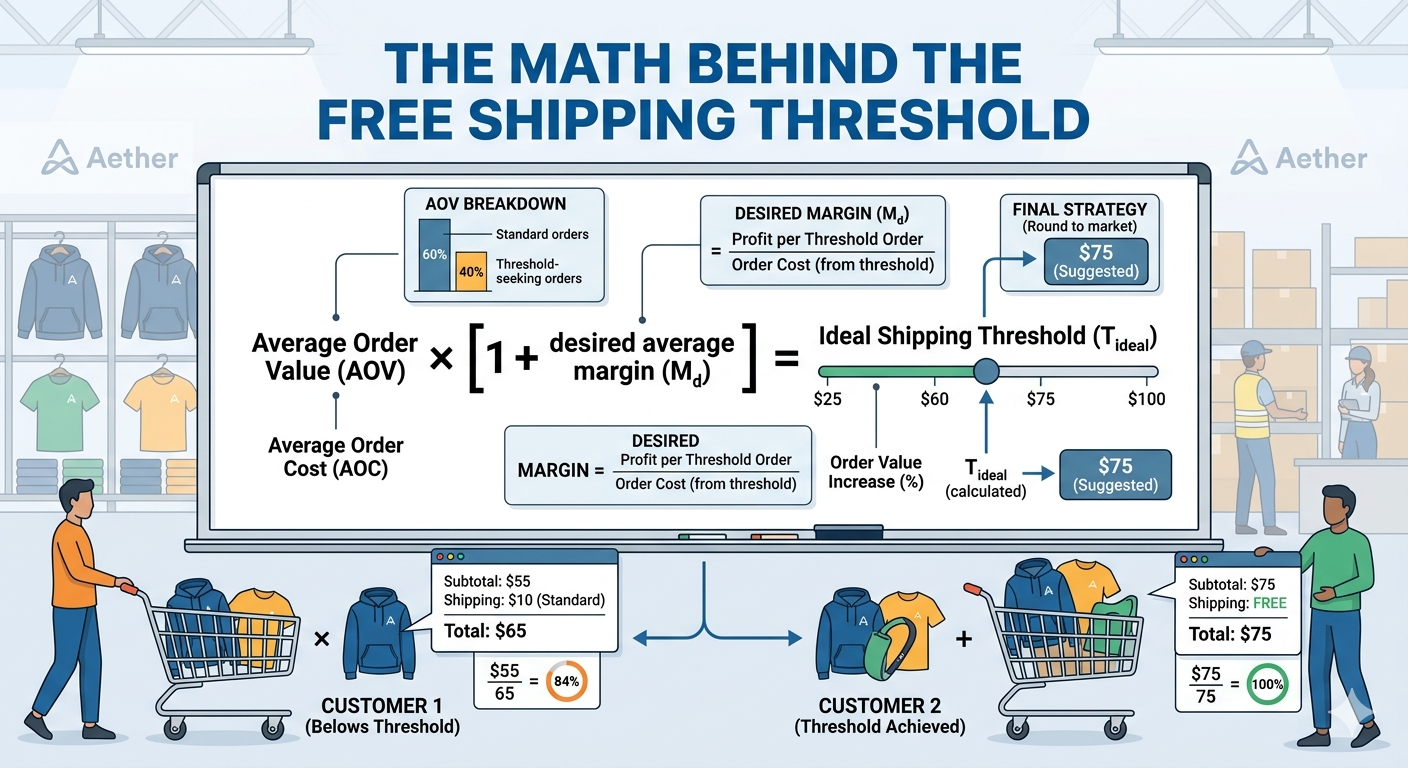
Here’s the logic. When a customer hits your free shipping threshold, you’re absorbing their shipping cost. You lose that 7.60 dollars in revenue that you normally capture. But you’re betting that free shipping increases their order value enough to compensate.
Let’s say you test a 75 dollar free shipping threshold. You need to calculate: what percentage of your customers will hit this threshold, and when they do, how much more will they spend because of the free shipping offer?
For this apparel brand, historical data shows: 42 percent of customers are already above 75 dollars (no impact). 38 percent of customers are between 50 and 75 dollars and would qualify for free shipping. 20 percent are under 50 dollars and won’t hit the threshold no matter what.
When you offer free shipping at 75 dollars, the 38 percent that are close to the threshold get incentivized to add more items. Studies show roughly 40 percent of them will increase their order to cross the threshold.
So 38 percent times 40 percent equals 15.2 percent of all orders will be incentivized to spend more. Those 15.2 percent average around 15 to 25 dollars in additional spend (they’re trying to hit the 75 dollar mark). Let’s call it 18 dollars average.
That 18 dollar extra spend carries roughly the same 30.7 percent margin = 5.53 dollars in additional profit per order (on average across all orders).
Meanwhile, you’re absorbing 7.60 dollars in shipping costs for orders that now hit your threshold. Not all orders, but roughly 15 percent of them (the ones you incentivized). So you lose 7.60 times 15 percent = 1.14 dollars per order on average.
Net math: gain 5.53 dollars from AOV increase, lose 1.14 dollars from free shipping absorption. You come out 4.39 dollars ahead per order. That’s a winner.
Why Lower Thresholds Seem Attractive But Kill You
The store owner’s instinct is usually to set a low threshold to be “generous” and drive conversions. So they set free shipping at 35 dollars instead of 75 dollars.
Now every order gets free shipping. You’re absorbing 7.60 dollars for nearly 100 percent of orders. There’s almost no upside in increased AOV because 90 percent of customers were already above the threshold. You’re just giving away 7.60 dollars.
You lose 7.60 dollars per order. Your 20.91 dollar margin becomes 13.31 dollars. Your profit per order drops 36 percent.
This is why Shopify stores running free shipping at 35 dollars look busy but aren’t actually profitable.
Combining Free Shipping with Order Limits Creates a Profit Machine
Here’s where it gets interesting. Free shipping thresholds and order limits work together to control customer behavior.
Set your free shipping at a level that’s profitable (usually 1.1x to 1.2x your AOV). Then use order limits to control how much customers can buy at once.
For the apparel brand with 68 dollar AOV, set free shipping at 75 to 80 dollars. Then set a maximum order quantity of 3 items per customer. This prevents someone from buying 10 items in one transaction (which would eliminate your margin).instead, they buy 3 items, hit your free shipping threshold, feel good about the deal, and come back later.
Now you’re controlling customer purchasing behavior and protecting your margin simultaneously. You’re using psychology to drive multiple smaller purchases instead of one large one that destroys your economics.
With SmartOrderLimit, you can set both the minimum order value (to qualify for free shipping incentives) and maximum quantities simultaneously. Customers see clear rules on their cart. They understand the boundaries. Your checkout doesn’t surprise them with hidden costs.
Real World Examples From Different Store Types
Jewelry store, 150 dollar average order value, 52 percent COGS, 12 dollar average shipping:
Recommended free shipping threshold: 180 to 210 dollars (1.2x to 1.4x AOV). This captures high-value customers while incentivizing others to add items.
Beauty/skincare store, 35 dollar AOV, 48 percent COGS, 5 dollar average shipping:
Recommended free shipping threshold: 50 to 60 dollars (1.4x to 1.7x AOV). Beauty customers buy multiples anyway, so a higher threshold makes sense and still drives repeat add-ons.
Fitness equipment store, 120 dollar AOV, 55 percent COGS, 18 dollar average shipping:
Recommended free shipping threshold: 150 to 170 dollars (1.25x to 1.4x AOV). Shipping is higher, so you need higher threshold to maintain margin.
The Calculation You Should Do Today
Open a spreadsheet. Get these four numbers:
- Your current average order value (from last 90 days)
- Your COGS as a percentage of revenue (ask accounting or pull from your accounting software)
- Your average shipping cost (from your carrier, multiplied by 1.2 to account for all-in costs)
- Your overhead rate (total monthly operating costs divided by total monthly AOV across orders)
Now calculate: AOV minus COGS minus shipping minus overhead equals your margin per order. That margin is sacred. Your free shipping threshold should be set such that the incentive doesn’t erode it.
A good rule of thumb: your free shipping threshold should be 1.1 to 1.4 times your AOV, depending on how much of your customer base is already above your AOV. If 60 percent of customers are already above your AOV, you can use 1.1x. If only 30 percent are above AOV, use 1.4x to protect margin.
Most stores that suffer from free shipping aren’t offering it too generously. They’re offering it at the wrong threshold and then not enforcing any quantity limits to protect their margin. Do the math first. Everything else follows.